
How Iowa Inmate Records Work
Iowa does not use one combined public jail roster for all counties. County sheriffs and local jail administrators maintain the records for people booked into county jails, law enforcement centers, correctional centers, and local holding facilities. Those records may appear in a web roster, a vendor portal, a daily list, a booking report, a jail phone response, or a Chapter 22 public-records request, depending on the county. The statewide directory is useful because it routes the search to the county that actually holds or booked the person.
The Iowa Department of Corrections, abbreviated IDOC, covers a different layer. IDOC operates nine correctional institutions, oversees the eight district correctional services departments, manages jail inspections, and publishes an official offender search for people in state prison, parole, probation, community-based corrections, work release, residential placements, and related statuses when the information is public. The IDOC tool is not a county jail roster, so a person arrested today may not appear there until a later state-custody event occurs.
The Iowa Offender Search is the statewide source for IDOC custody and supervision records.
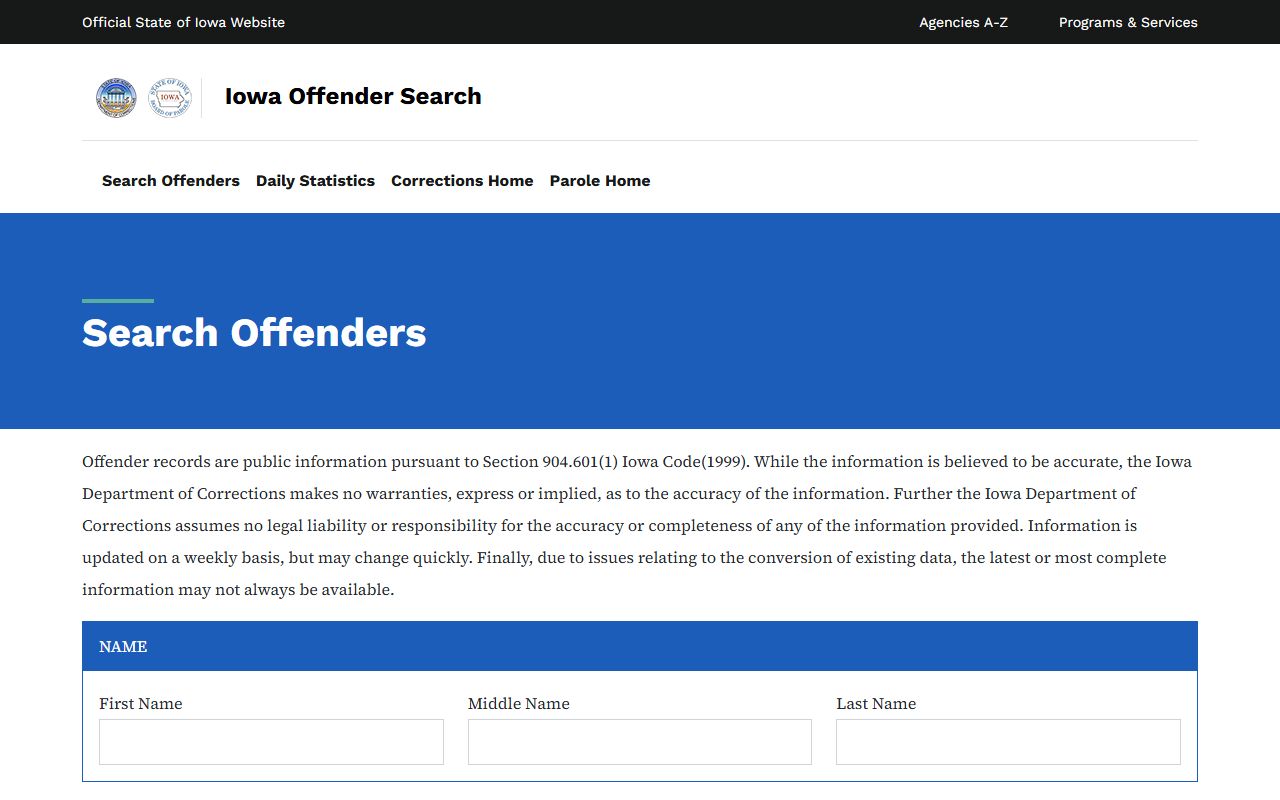
This screenshot fits the Iowa inmate records path because IDOC search is the state-level locator once a person is under Iowa Department of Corrections custody or supervision.
Find Iowa Inmates by Status
The fastest search path starts with a status question. A person who was booked after an arrest belongs first in the county roster or county jail contact channel. A person serving a state sentence, supervised on parole, or placed in an IDOC residential or work-release setting belongs in IDOC Offender Search. Federal and immigration cases use separate national systems. Iowa VINELink can add notification support, but it is not a full replacement for jail, court, DOC, BOP, or ICE records.
- Search the IDOC offender locator if the person is serving a state sentence, on parole, on probation, in work release, or otherwise under published IDOC supervision.
- Use the County Directory if the person was just arrested, is awaiting court, is serving a short local sentence, or appears to be held by a sheriff.
- Open the county roster, sheriff jail page, or county contact route documented for that locality. Iowa county systems vary, so do not assume every jail has the same search fields.
- Use the Federal Bureau of Prisons locator for sentenced federal custody from 1982 to the present.
- Use ICE ODLS when immigration detention is possible. ICE profiles identified in Iowa include Polk, Pottawattamie, Sioux, and Muscatine county jails, all covered by existing county folders.
- Use Iowa VINELink for custody-status notification where a participating agency publishes a matching record.
VINELink's Iowa entry point is available through Iowa VINE.
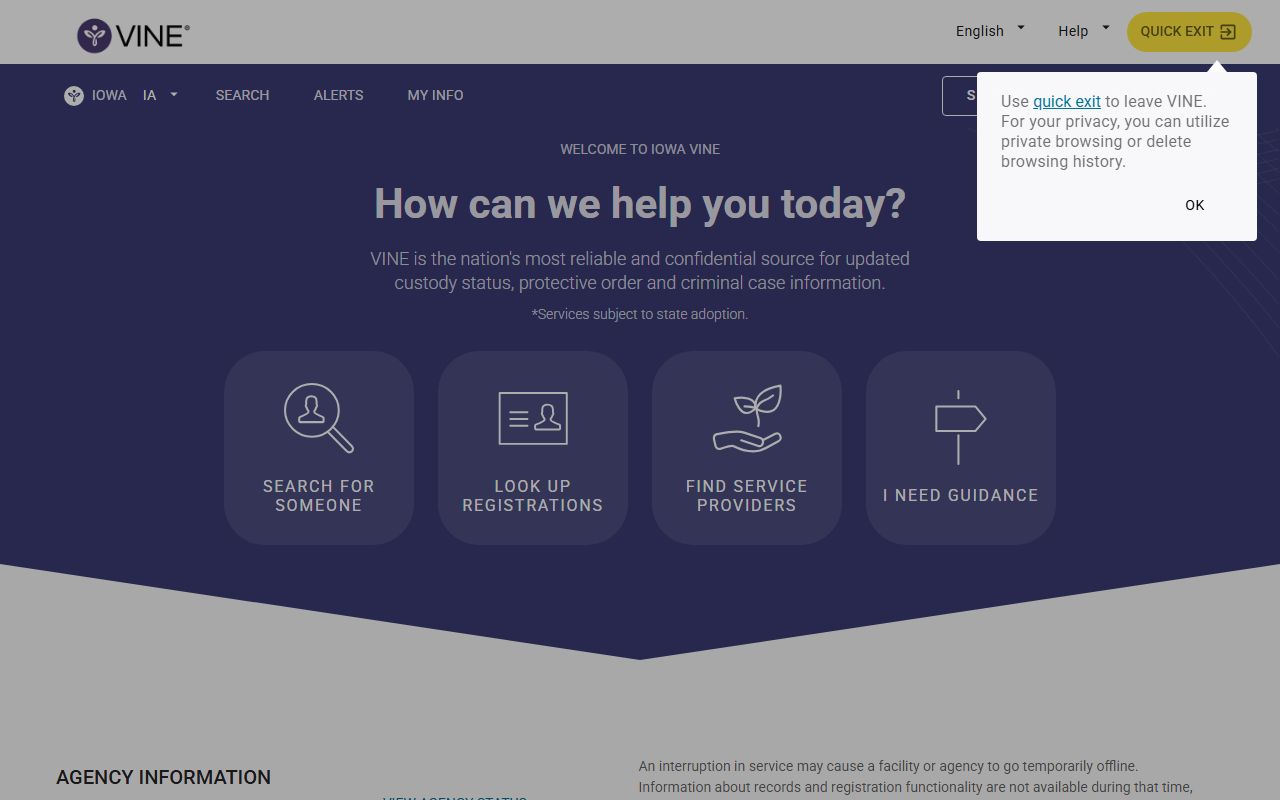
VINELink is most useful after the correct jail, court, or IDOC record has been identified, because its role is notification rather than a complete statewide roster.
Iowa Custody Systems Compared
Different agencies publish different inmate records. A county sheriff roster is built around booking and jail custody. IDOC search is built around state custody and community supervision. BOP and ICE are federal systems. Iowa Courts Online is not an inmate locator, but it helps connect a booking to charges, case numbers, filings, court debt, dispositions, and hearing history after a prosecutor files a criminal case.
| Custody or Record Type | Run By | Where to Look | Best Use |
|---|---|---|---|
| Recent arrest or local jail custody | County sheriff or local jail | County jail roster, sheriff contact, or Chapter 22 request | Booking, charges listed by the jail, bond, housing, booking photo where published |
| State prison or supervision | Iowa Department of Corrections | IDOC Offender Search | Offender number, location/status, county of commitment, offense and sentence fields where public |
| Federal sentenced custody | Federal Bureau of Prisons | BOP inmate locator | BOP register number, federal location, release status, federal release-date caution |
| Immigration detention | ICE | ICE Online Detainee Locator System | A-Number search or biographical search for immigration custody |
| Filed criminal case | Iowa Judicial Branch | Iowa Courts Online | Charges filed after arrest, case events, dispositions, court debt, hearings |
The Federal BOP inmate locator remains relevant even though this research did not locate a BOP institution physically in Iowa.
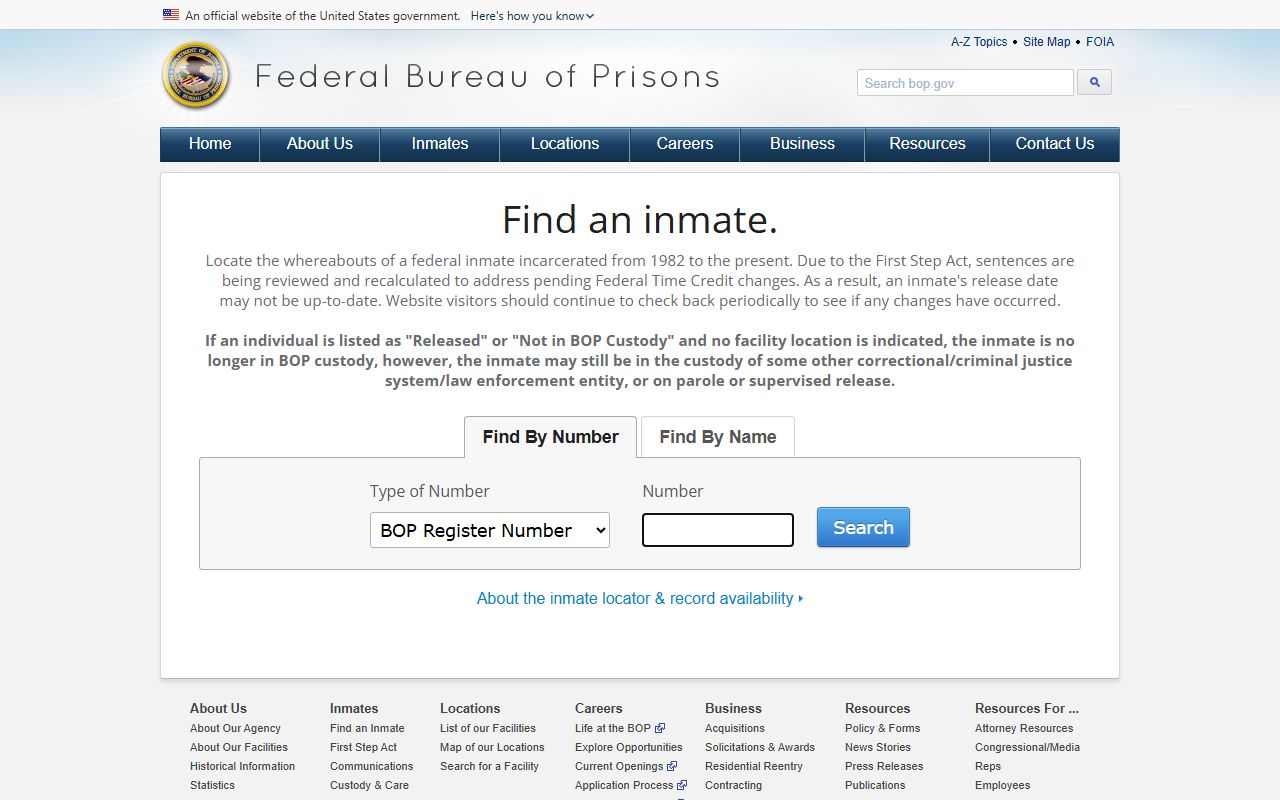
Iowa residents and federal defendants can be housed in federal facilities outside Iowa, so the BOP locator belongs in a complete Iowa inmate records search chain.
Iowa Jail Roster Fields
County roster details vary across Iowa. Some county files document strong online rosters with current inmate lists, mugshot images, charge fields, bond fields, or portal search tools. Others document no public online roster and route users to a jail phone line, sheriff records staff, or Chapter 22 request. The field list below describes common record elements, not a promise that every county publishes each item online.
| Field | Where It Usually Appears | What It Means |
|---|---|---|
| Name | County roster and IDOC search | The public identity field used to match the person, subject to spelling and alias issues. |
| Booking number or offender number | County jail or IDOC record | A local booking identifier differs from an IDOC offender number and from a BOP register number. |
| Booking or admission date | County jail or state profile | The date tied to local booking or entry into a state custody stage. |
| Charges or offenses | County roster, court case, IDOC profile | Jail charges may differ from the final prosecutor-filed court charges. |
| Bond or sentence information | Roster, court record, IDOC profile | Bond is a pretrial release term; sentence fields relate to conviction and commitment. |
| Facility or status | Roster, IDOC, BOP, ICE | The place or status should be confirmed before visiting, sending mail, or posting money. |
IDOC's public search form links the statewide record to defined fields and filters. The official form includes name fields, offender number, sex, location, offense, and county of commitment.
IDOC Search Fields
The IDOC search page states that offender records are public information pursuant to Iowa Code section 904.601(1), but also warns that information is believed accurate rather than warranted. The research notes that IDOC information is updated weekly and can change quickly. A missing result should not be treated as proof that the person is not in jail, has no criminal case, or is outside all custody. The person may be in county custody, under a non-DOC status, recently transferred, listed under a different spelling, or held by a federal or immigration agency.
| Search Field | How to Use It | Caution |
|---|---|---|
| First, Middle, Last Name | Start with last name, then add first name for common names. | Use Starts With or Sounds Like when spelling is uncertain. |
| Offender Number | Use it when a prior IDOC profile or court file gives the exact number. | It is not the same as a county booking number. |
| Sex | Use as a narrowing filter when known. | Over-filtering can hide a valid match. |
| Location | Narrow by prison, district, compact status, or community corrections location. | The location field reflects IDOC data, not every county jail. |
| Offense | Use only when the offense label is reliable. | Court charges can change after filing. |
| County of Commitment | Filter by the Iowa county tied to commitment. | It may differ from the current physical facility. |
Release timing should not be estimated from a sentence length alone. Iowa Code chapter 903A governs earned time for people committed to the custody of the director of the Department of Corrections. Iowa Code section 903A.2 describes earned-time categories and credits, while section 903A.3 allows forfeiture of accrued earned time after rule violations, failure to complete specified treatment programs, or certain dismissed inmate litigation. Court credit, detainers, parole-board decisions, treatment requirements, and supervision conditions can also affect the practical date.
The IDOC Districts and Prisons page explains the state prison and district correctional services structure behind many search results.
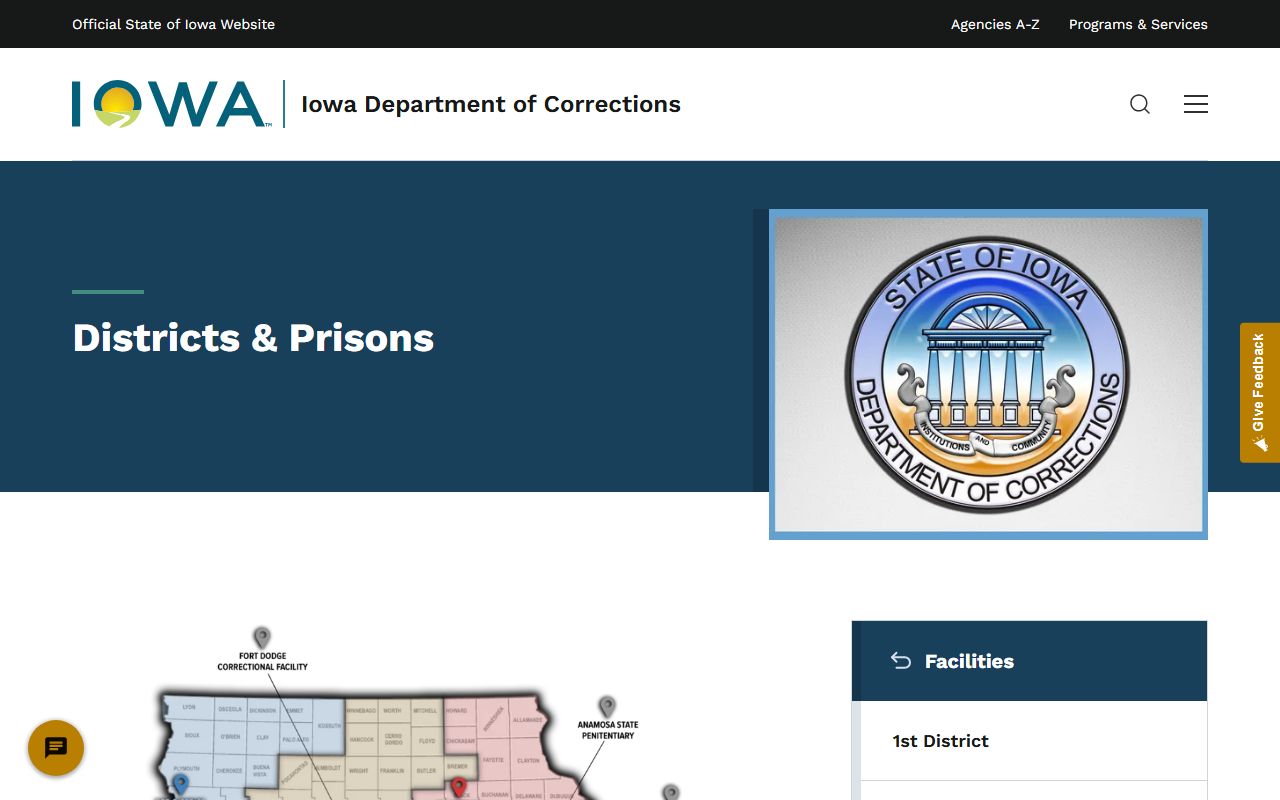
That statewide structure matters because an Iowa inmate record can point to a prison, district correctional services department, work release, residential setting, parole, or probation status.
Iowa Public-Records Requests
Iowa Code chapter 22 is the statewide open-records framework. Section 22.1 defines public records broadly for state and local public bodies, and section 22.2 gives every person the right to examine and copy a public record unless another law says otherwise. For county jail records, the lawful custodian is usually the county sheriff or jail. Requests should go to the county that holds the jail record, not to IDOC, unless the requested record is actually an IDOC record.
IDOC records have a separate limit. Iowa Code section 904.602 controls what information may be public for current or former incarcerated individuals and district department clients. IDOC's open-records page says requests should be specific with terms, keywords, and date ranges. It also says the department is not required to create a record, conduct research, analyze data, or answer questions. Confidential information requires a release, subpoena, or court order.
Records route: county jail record to the county sheriff or jail custodian; IDOC record to IDOC Open Records; filed court case to Iowa Courts Online or the clerk; federal record to the federal agency.
The IDOC Open Records Request page gives the state prison and community-corrections request path.
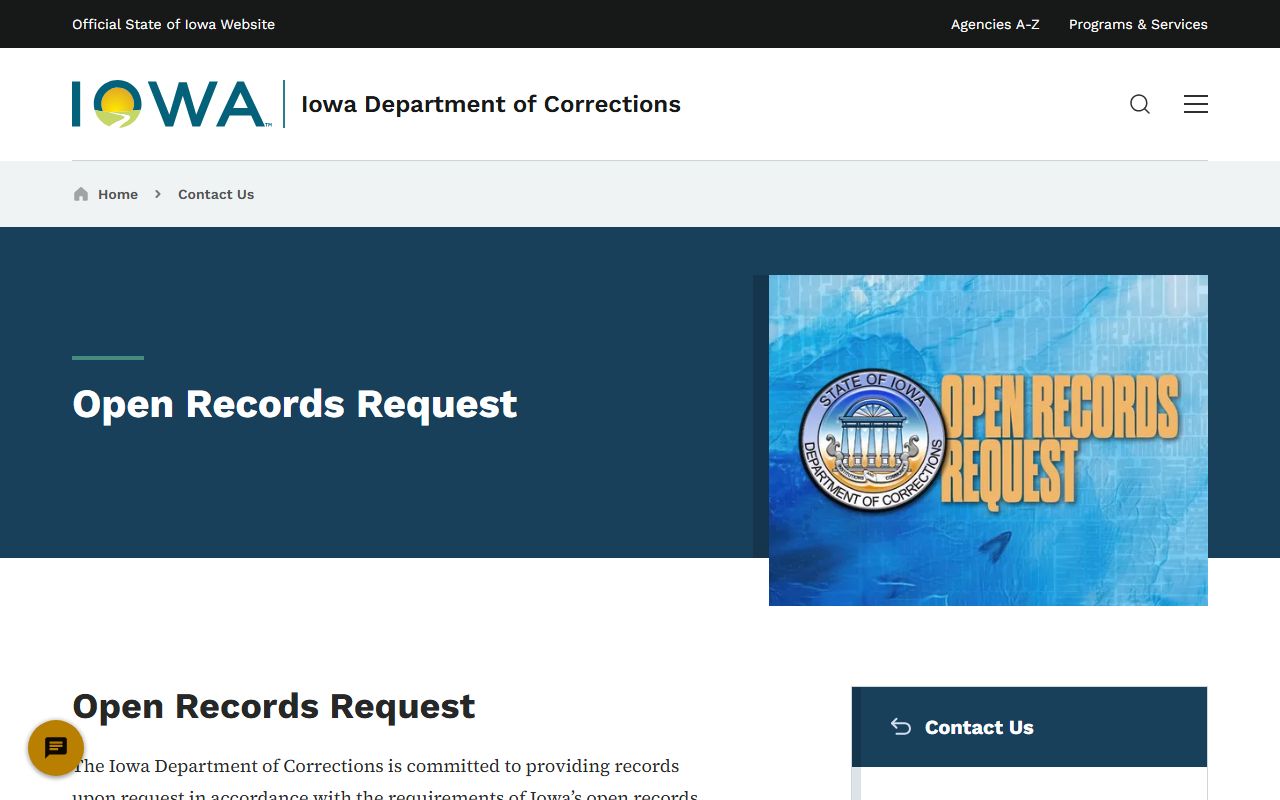
This request channel is for Iowa Department of Corrections records, while jail booking records still route through the county custodian under Chapter 22.
Iowa Detention Facilities
Iowa inmate records also depend on the facility type. County jails hold recent arrests, pretrial detainees, short local sentences, and some people held for another agency. IDOC prisons hold sentenced state-prison populations. District correctional services can supervise parole, probation, pretrial services, work release, residential facilities, and related community placements. Juvenile facilities, including those documented in Woodbury, Polk, and Scott county research, should not be treated as adult public jail rosters unless a source specifically supports that use.
Use the Iowa Facility Directory to separate county jails, state prisons, residential/work-release facilities, juvenile detention, and Iowa jails with ICE facility profiles. Use the County Directory when the first known fact is the county of arrest or booking.
Note: before visiting, sending money, or relying on a release status, confirm the current record with the facility or official portal.